Molecular construction has been taken to an entirely new level! Asymmetric synthesis has always been a source of PAIN for us personally during our time at university. We wish to form one of the two enantiomers. Ok how? Block off one using steric effect? Wait, what? But how do we ensure that we get ONLY one of the isomers? Well… we can’t really… but we can maximize the % of the isomer we want, and use other methods to ‘remove’ the one we do not want.
Honestly, we were quite lost during the lecture courses themselves, and had to really dig into our own research to keep up.
This infographic from Compound Interest sums it up pretty well 🙂 as always!
Nobel Prize in Physics 2021 was also of great importance to us Chemists as well, as it was basically on Climate Change.
Since the 1980s, we’ve seen advertisements about why we should stop using Leaded petrol. Those who are as middle-aged as we are would have seen those ads. Recently, in Algeria, which was the last country to still sell leaded petrol, ran out of it’s last supplies (in July).
This means that there are no more countries in the world that uses leaded petrol for cars and lorries! With the world in the midst of an ongoing pandemic, this is excellent news for the Chemists! We need to celebrate every victory we can get and this is a huge one.
As a child, I once did a research project on Leaded Petrol vs Unleaded Petrol. Cycling to the National library was our best way of doing research in the early 90s. (Also, we did not emit any fumes by cycling back then ^_^) Anyway, the results of my research were horrifying. Leaded petrol was linked to heart disease, cancer & stroke, as well as brain development in children. Fortunately, even in my country of Brunei, the government had already been advising citizens to buy “Green” fuel rather than “Red” (back then it was color coded as thus, and then later totally removed from sale).
Most high-income countries had banned the fuel by the 1980s and that was to correct the mistake we made ever introducing leaded petrol in the 1920s, which was thought to improve engine performance.
Taken from the awesome Andy Brunning’s stunning Chemistry Infographics website Compound Interest!
Some striking features in this infographic from 2016 caught my eye recently and that was the energy output per litre between Petrol & Diesel fuels. A stunning 3.2MJ per litre! This is why Europe was keen to push for Diesel fuels. However, as with most things in Science, there are always double-edged swords. Diesel fuels require constant maintenance on their filter. The emissions don’t just leave a bad taste in your mouth but have lasting bad effects on our lungs & bodies too!
Anyway, back in 1924, five workers were declared dead & dozens more were hospitalized after suffering convulsions at a refinery run by the US oil giant Standard Oil. This was the first alarm that was raised and Scientists started to correct their mistakes (as always). However, despite this, lead continued to be added to all petrol globally until the 1970s and a decade+ being outright banned. Finally, until just July this year… it finally ran out.
Such are the issues surrounding the Electric Car, EV1s that were sold in the US around the same time as leaded petrol was being eradicated but the never ending battle between Scientists with ethics vs corporations driven by profit will go on…
The UN’s environmental body UNEP has worked with governments, private companies & civic groups since 2002 to end the use of leaded petrol but their power & influence has always been stymied by various other factors. Greenpeace called this eradication of leaded petrol, “the end of one toxic era”. This current generation is very fortunate to have been born at the end of this era… and will continue to Greta Thunberg the heck out of today’s politicians and bring a literal ‘Green New Deal’ that truly makes the world a better place for our children.
Unfortunately, in our country of Brunei Darussalam, after having 0 local cases for over 437 days, there were 7 cases & 1 imported case according to the Press Conference by our Ministry of Health on Saturday. As always, our Ministry of Health takes such matters very seriously & a few honorable Ministers attended the Press Conference wearing Masks despite them all having completed 2 shots of their respective vaccines against COVID-19.
What this means for educators in Brunei is that we are back to Working from Home for our own safety & to effectively curb the spread. Fortunately, we have been uploading notes online since 2008. Feel free to use the drop down menus above to access some revision notes for 9701 Chemistry A-Level Syllabus.
For my classes at school, we are doing Online Classes with the assistance of OneNote this time. Our students have access to syllabus notes as well as some screenshots from last year’s Online Lessons.
Honestly, we don’t feel very optimistic this time around… but we have a unique opportunity to make full use of the Online Resources we have accumulated over the past few years. Online Quizzes. Online Notes. Online Practical Videos. IGTV Tutorials. YouTube tutorials (We recommend ptetchemistry YouTube channel).
Press Conference has been delayed today. (was scheduled to start 10 minutes ago) Hopefully the clusters did not expand too much. Stay safe & healthy everyone~!
This has always been a nice topic for us. We’ve debated the names & bond angles endlessly but in the end, we just accept the names & values as given by our examination board.
We especially like those that are beyond the syllabus, as those are quite often asked during Oxbridge interviews (it happened to us 20+ years ago during interview at Balliol College, Oxford University).
Students were instructed to make mind maps and/or summary sheets, or otherwise. Their submissions left us awestruck! 🥰🥰🥰 awaiting their permission before we post here.
Some of these were out of the syllabus, but as we love adopting the Japanese lesson practice of allowing students to challenge themselves, we included these anyway but after explicitly telling them that they are going beyond the syllabus. Isn’t the goal of education to expand our horizons, not just to pass exams?
Can’t wait to share some of their awesome mindmaps!
From the very first conclusive report of a virus … to the eventual release of a vaccine, over a year has passed. As a Biochemist by Specialty, we spent a great deal of our academic life getting to understand quite a great deal about chemical reactions that occur inside our bodies.
Even decades later for us, there is still just so much we do not know. Weeks spent just recreating reactions inside test-tubes, hours wasted just sitting around a centrifuge or awaiting a reflux reaction to reach the stage we needed. And at the very end, results were discarded due to a single missed step, or a sudden change in reaction conditions that resulted in yet another failed “recreation”.
This is why, as Scientists, we understand such Timelines very well. We have always advised our students to hone their skills in Mathematics; to not neglect the importance of Calculations in A-Level Chemistry, as these are vital in even being able to provide viable data regarding chemical reactions.
From the infographic above, quite a lot of Biochemical terms are mentioned & years & years of study are required to properly understand why it simply took this long. Honestly, as Biochemists, we weren’t expecting a vaccine to be released for public usage this soon at all. Take heed with the efficacy numbers for each “brand” of vaccine. The implications are seldom pointed out but take heed indeed.
Language skills are just as important! Without a modicum of prowess, how could a Scientist be able to communicate their results effectively to the public (majority non-scientists) and convey a sense of security & trust?
For our incoming Lower Sixth students , heed this warning well… do NOT even consider enrolling for A-Level Chemistry without a strong background in Mathematics & English. Either you’ll just be taking up Chemistry for the sake of taking a subject to fill up your timetable, or you’ll just end up struggling throughout the course, or BOTH. At the very end, if you’re seriously pursuing a Degree in Chemistry, things only get exponentially harder. So, please think long & hard, for your own sake!
About a month ago, we decided to start over with a new account on IG @maxim.chem.musings . Please visit our account, follow, like & share! Thank you!
Fast forward to now, we have had 3 Posts of the Week (PotW), a few Organic Mechanism video reposts, some snippets from Laboratory Practical sessions & a few tutorials/question posts.
We believe in equity in education for all. While it is true that one can be born in a more suitable educational environment and thus have an edge, we believe that one should strive for one’s education no matter what. One should simply stop comparing themselves with others and just focus on their own education, with or without a teacher.
We have found loads of amazing content online, on IG, on Facebook, as well as plenty of other social media platforms. Yes, we need to verify that what we learn online has been peer-reviewed, but at least it is a start.
Try to constantly update yourselves, not just about syllabus content, but also on the forefront of science. Keep on upgrading yourselves!
Compound Interest has just released a new infographic regarding The Science of Exercise. As always, they make my favorite infographics! Just enough information for your average person, with the avenue for you to do further research via links.
As Chemists, let’s talk about the chemicals involved:
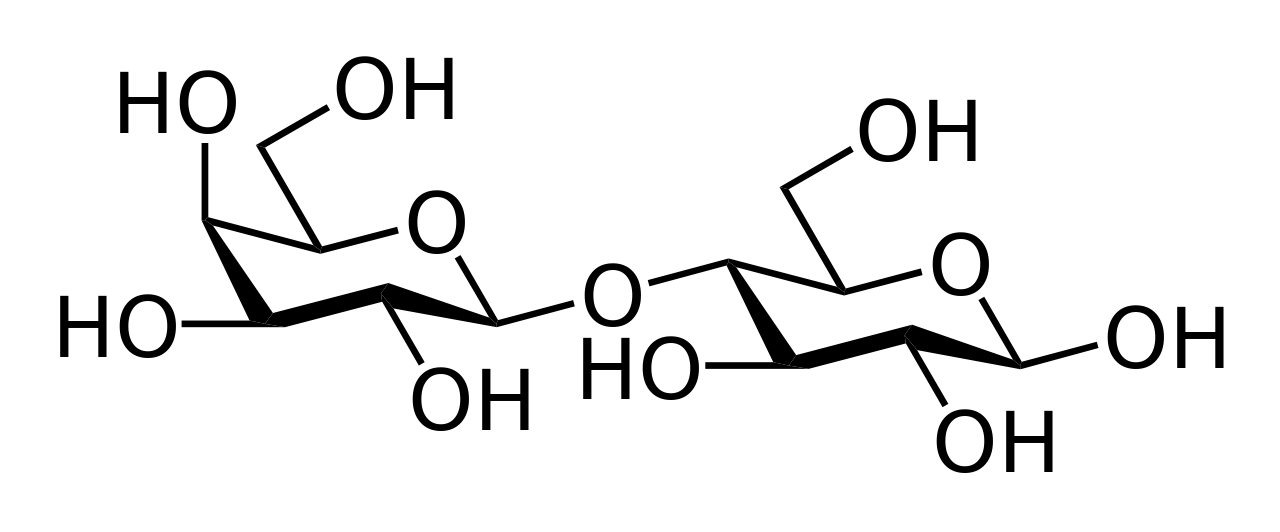
Carbohydrates Biomolecules consisting of Carbon, Hydrogen and Oxygen atoms, usually with a H:O ratio of 2:1 (as in water) and thus with the general formula Cm(H2O)n, where m may be different from n, and also with exceptions, such as deoxyribose*.
Another Bane of my existence… Lactose… which I am heavily intolerant of!
Carbohydrates serve numerous roles in living organisms. Polysaccharides (such as starch and glycogen) serve for storage of energy, as well as structural components (such as cellulose and chitin). Ribose is an important component of coenzymes and also the makes up the backbone of RNA while *Deoxyribose makes up the backbone of DNA. There are numerous other uses, as always, along with their derivatives.
Electrolytes For this case, they would mean the substances that are used to balance fluid levels in the body via the use of semi-permeable membranes & concentration gradients (cf. Osmosis)
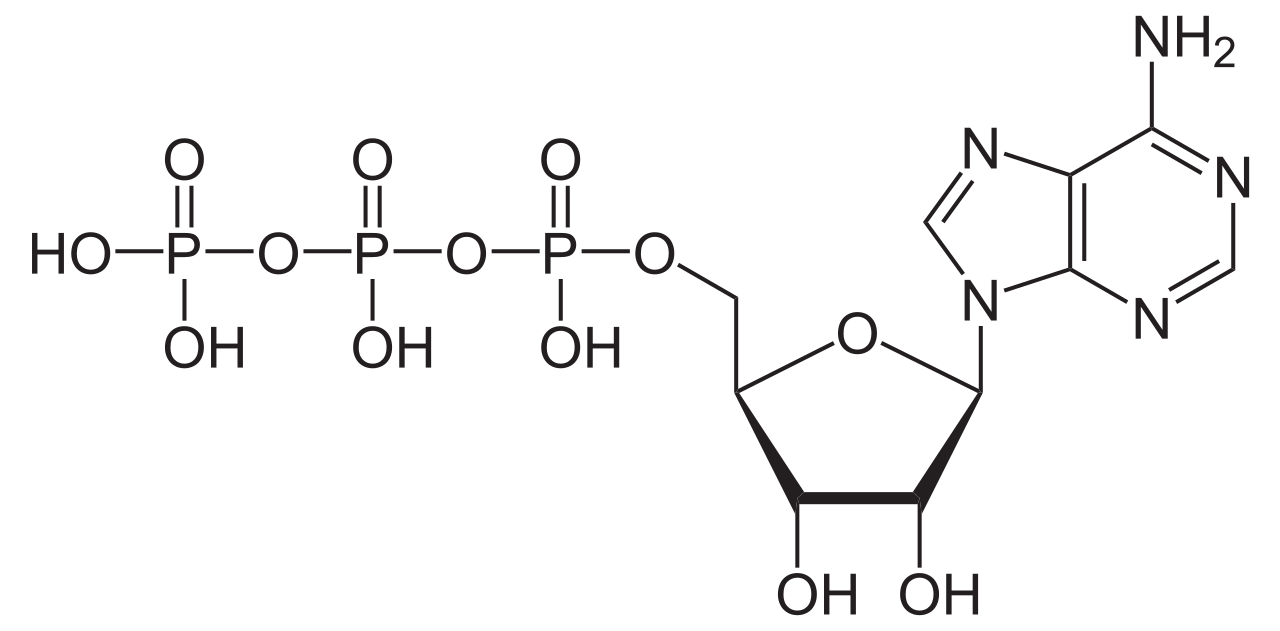
Adenosine Triphosphate (ATP) Most take the energy value of foods literally. Rather, they should think in terms of the “molecular unit of currency” of intracellular energy transfer that is ATP.
Adenosine Triphosphate (ATP)
During many processes in living cells, e.g. muscle contraction, nerve impulse propagation, and chemical synthesis, ATP is converted to ADP or AMP. This process generates energy, as given by chemical energetics. (ATP is regenerated by other processes, most notably respiration, which us Biochemists have spent decades of our lives learning about)
Let’s say Person A wants to workout. First of all, 1 calorie is roughly 4.2 Joules of energy, so that would be about 4.2 kJ of energy. To cut the story very very short, for every 7300 calories (over 30kJ) stored, 1 mole of ATP is formed. That’s 6.0 x 10²³ ATP molecules formed. Now 7300 calories is really high! Generally, the recommended daily calorie intake is 2000 calories a day for women & 2500 for men. This is, of course, subject to your body type, amount of physical activity per day, existing medical conditions, etc.
Now, I am supposing that Person A wants to play basketball. DISCLAIMER: These are just general estimates! During a basketball game, about 85% of the athlete’s energy comes from the phosphagen system and 15% from the glycolytic system (anaerobic), and a small % comes from the oxidative pathway (aerobic).
-Rebounding is pretty intense and would likely use the ATP-CP for a quick burst of immediate energy. (phosphagen system)
-Fast breaks can be moderately to very intense depending on sustainability -by the athlete and usually would require the glycolytic system to supply energy. Anaerobic glycolysis releases ATP and produces lactic acid (also explains why you will be sore). These moderate-intensity activities also include full-court defensive pressure or motion offensive plays.
-what about the oxidative energy system (aerobic)? Although it is the least used system in basketball during a match, it is one of the most important for basketball success (and most skills!) During the entire game, the oxidative system is essential for continuous play as they replenish the energy stores while the phosphagen & glycolytic systems are releasing ATP and producing lactic acid.
Note that all the above processes require the use of ATP, NOT our carbohydrates, i.e. what we eat. For that, please look up the process of Respiration.
I have always been highly skeptical of “Calories burnt” calculators and similar ‘measures’. Looked up for basketball values and it reads that the average person ‘burns’ 575-775 calories per hour in a game of basketball. If they are shooting baskets, they will ‘burn’ 325-450 calories per hour. Of course, this is subject to the intensity of the player. Now what about metabolic state of Person A? High metabolic rate vs low metabolic rate?
I used this “Calories Burned Calculator” and input my data in. It seems, for my weight… I will only burn 236-488 calories per hour. Interesting to note is that basketball officiating would burn 368 calories per hour, which would be more than shooters! Also, you burn more calories per hour during TRAINING than you do in GAME. (THIS I APPROVE).
Let’s now look at Person B during our Quarantinewhile… doing nothing at home. Will Person B burn any calories? YES! Depending on our body weight, a person burns calories to sustain the body, e.g. repair… respiration… etc.
Person B weighs 150 pounds, and so might burn 46 calories an hour doing nothing. While sleeping, 322-414 calories will be burnt. The heavier you are, the more calories you will burn just by doing nothing. This is just relativity speaking (in a sense). Now the estimate figures for sleeping have immense significance! By having a full night of sleep, one can burn more calories than an hour of shooting basketball!
Finally, we come to Highs & Cramps. I love this section as it revealed to me a misconception that I’ve had my entire life! I even stated above that lactic acid may cause soreness but in the infographic above, it states that this is not proven and that there are other hypotheses. Very interesting, and will be digging further into anandamide as well as the other hypotheses for why we feel sore after workout.
Anandamide – apparently these contribute to that feeling of ‘high’ after you score a crucial basket during a match!
I hope this article was enjoyable to read. I honestly enjoyed looking up the individual aspects, and doing the personal calculation for my own calorific study. Maybe it’s time to focus less on just what you eat, but also your workout lifestyle. Working out should NOT be an event… it should be a habit instead.
Yes, yes, I know… the drug trials for RDV have been inconclusive. But I found this synthesis pathway as credited above, and the Chemist in me just smiled evilly 😀
As I worked on my Masters in Pericyclic Chemistry, as well as other key areas of Organic Synthesis, most of the above is familiar to me. I suddenly recalled all those hours spent per week doing practicals with my Practical Partner from Russia. Oh Dr Yakovlev… be safe & healthy!
For my Chemistry students, please scrutinize each step. Predict the conditions where applicable, and imagine all the mechanisms that are in play in each step!
As always, I turn to the genius of Compound Interest! Here is an updated infographic depicting the Twenty Common Amino Acids, classified according to their side chain (-R group). Aliphatic, Aromatic, Acidic, Basic, Hydroxylic, Sulfur-containing and Amidic are the classes here, but even within some, there are further details. E.g. for tryptophan, the side chain is aromatic, but also has a secondary amine.
Today in class, we discussed four reactions of amino acids:
Decarboxylation (loss of CO2; histidine becomes histimine, which is responsible for allergic response. As part of an immune response to foreign pathogens, histamine is produced by basophils and by mast cells found in nearby connective tissues. Histamine increases the permeability of the capillaries to white blood cells and some proteins, to allow them to engage pathogens in the infected tissues. Of course, this leads to quite a few problems and sometimes we take anti-histamine to reduce our allergic response.)
Reduction (for cysteine; forming disulfide bridges that are important in maintaining the tertiary structure of a protein)
Condensation reactions (between -COOH and -OH/-NH2 and vice versa, forming amide links & esters.)
Dehydration by Phosphoric acid to form a phosphoester bond. (Yes, this looks a lot like the reaction between sugars and ATP; the chemistry is essentially the same, just an extension)
Then, we delved into the individual amino acids themselves to discern if they could do any other reactions, and found a LOT of possibilities!
To become adept at organic synthesis, one must first know all about the reactions of functional groups. Without this, one will find the entirety of Organic Chemistry a real pain. As a Biochemist, I used to make Flash Cards with functional groups and some brief descriptions whilst I was at O- & A-level. As I progressed to University, the cards became more and more numerous, as well as more and more detailed.
My procedure for answering Organic Reaction or Mechanism questions was usually as follows:
Draw the skeletal formula (in 3D representation if needed)
Highlight functional groups
Label dipoles (so important!!!) & active lone pairs
“Push electrons” (curly arrows or even half-curly arrows)
Check intermediates / transition states
Score more or less free marks 🙂
Some of the steps above can be skipped, but please do check the marks allocated for each question, as they would give you an idea of how much information you need to depict in your answer.
Personally, among Physical, Organic & Inorganic Chemistry, I found Organic Chemistry to be the easiest. I scored full marks for my Inorganic Papers whilst in A-level but that was simply because memorization is the EASIEST skill, hence BOTTOM of Blooms’ Taxonomy. Organic Chemistry required a deep level of understanding. But if you have that, you can even encounter NEW organic compounds, and predict their reactions! With the correct skillset, you can draw up synthetic pathways, design more efficient routes, etc!
I chose to read Organic Chemistry for my Masters, specifically Pericyclic Chemistry. Some of my work is still up on Oxford University’s website. Unfortunately, Flash Macromedia is obsolete, and my work cannot be viewed in full now. But I am proud to say that my work won the RSC Exemplarchem Prize in 2003, which netted me a plaque and 500 pounds. The money was donated to charity, and I must thank my Supervisor for recommending my work to RSC, and guiding me towards completing my MChem ❤
Biotechnology has always been a very important field, as right now, with these dark times, my colleagues have stepped up for us. May they all remain safe & healthy… always.
Hydroxychloroquine… oh hydroxychloroquine. If you were a figure on Instagram or Twitter… I am sure that you would have millions of followers by now. Doesn’t matter if it works or not (Yes, I believe it works, somewhat)… people need HOPE now. But do NOT self-dose if you are healthy. It will do more harm than good. Also, no matter what drug you are taking, ALWAYS get a prescription from a Doctor (MD or DO). Calculations need to be made! Critical things such as calculations need to be made, and also medical histories need to be reviewed in case of allergies or other complications from taking HCQ (or Plaquenil and other brand names).
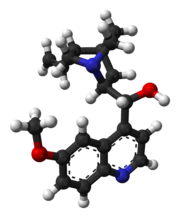
Historically, when malaria plagued the world… Quinine was the first-line treatment for malaria as recommended by WHO. As a child, learning about malaria vs sickle-cell anemia from my Science teacher, I was fascinated and traveled to our BSB library to look up Quinine. Back then, there was no internet, so everything had to be learnt through books. I found out back then that in 1820, Quinine was isolated from the bark of a cinchona tree (yes, I still remember this from my childhood as it was like a mystical story for me). A piece of bark from a tree could cure such a deadly disease???? WOW!
Quinine
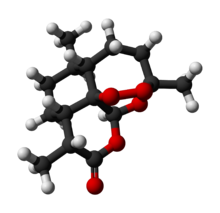
I have featured Quinine as the Molecule of the Month before, in 2009. And then came Artimisinine, which is now the go-to drug for malaria, discovered in 1972. Tu Youyou, a Chinese Pharmaceutical Chemist & malariologist (I hope that’s not something I just made up -_-) won the 2015 Nobel Prize in Medicine for her research and it saved millions of lives in South China, SEA, Africa, and South America.
Artemisinine (qinghaosu)
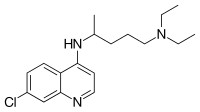
Now back to hydroxychloroquine, which is an analogue of quinine. It is a derivative of chloroquine, which was discovered by Hans Andersag & coworkers at the Bayer laboratories, who named it Resochin. It was ignored for a decade, because it was considered too toxic for human use* (We will come back to this later).
Chemists will be able to immediately tell the difference between chloroquine (left) and hydroxychloroquine (right) by the additional hydroxy group on the top right of the molecule. The IUPAC name for hydroxychloroquine is… UGH is the word for it:
(RS)-2-[{4-[(7-chloroquinolin-4-yl)amino]pentyl}(ethyl)amino]ethanol
Molecular formula: C18H26ClN3O
Molar mass: 335.872 g mol−1
DISCLAIMER!!! I do not endorse nor deny the applications of hydroxychloroquine. I merely chose the drug as it is a subject of heavy debate in the world at this very moment. But I am against self-dosing unless you are a doctor (even doctors will admit that when it comes to their own selves, they can be bad patients).
Why is this drug so important now? It is being studied as an experimental treatment for COVID-19. A question that should pop into your mind right now should be: Eh?? Isn’t this drug for malaria?? How can it be used to treat COVID-19? This is a question that is too often NOT ASKED. But I am actually more concerned with *the toxicity of this drug that left it’s original form chloroquine untouched for a decade.
Even when used for treatment of malaria, common side effects include vomiting, diarrhea, headache, changes in vision, and muscle weakness. These are just the common side effects. Yes, this drug is listed on the WHO’s List of Essential Medicines. It is also the 128th most-prescribed medication in the United States, with more than five million prescriptions. Now, if you think about this figure right now… there should be a lot of supply in the USA.
Let’s talk about the more severe side effects. HEART PROBLEMS, LIVER FAILURE, MUSCLE ATROPHY. The risk of death from overdose is significant as well. Yes, what have we got to lose, right? I believe that compassionate use may outweigh this, but as always, it has got to be a case by case basis. Don’t self-dose with this if you are healthy or having mild symptoms of covid-19, especially for children and pregnant mothers!
As of 3rd April, 2020, there is limited evidence to support the use of HCQ to treat COVID-19. This is NOT a statement saying it does not work. What is means is that, there are many other factors to consider before they can place it a front-line drug. Safety evaluation in different age demographics of people, studies of other known complications in patients with existing medical conditions, dosage calculations, etc.
Antiviral effects: It increases late endosomal and lysosomal pH, resulting in impaired release of the virus from the endosome or lysosome. This prevents a virus from releasing its genetic material into the cell and replicate. It also seems to act as a Zinc ionophore, that allows extracellular Zinc to enter the cell and inhibit viral RNA-dependent RNA polymerase. Sounds good right? But don’t go and drink alkaline concoctions. That will damage your stomach and cells along the way. This won’t help either! Also, don’t go and spam Zn tablets. Again, this is a reaction at the cellular level. What you do to your alimentary canal will have limited effects on the disease, if any.
On January 2020, Chinese medical researchers stated that exploratory research into chloroquine seemed to have “fairly good inhibitory effects” on the SARS-CoV-2 virus.
Chloroquine has been approved by Chinese, South Korean and Italian health authorities for the experimental treatment of COVID-19. These agencies noted contraindications for people with heart disease or diabetes. Here comes the IMPORTANT PART:
Chloroquine has a relatively narrow therapeutic index and it can be toxic at levels not much higher than those used for treatment!!!!!! EASE OF OVERDOSE ALERT!!!
On 28th March 2020, the FDA authorized the use of HCQ and chloroquine under an Emergency Use Authorization (EUA). The treatment itself has not been approved by the FDA. There is a key difference there. The experimental treatment is authorized only for emergency use for people who are hospitalized but not able to receive treatment in a clinical trial.
On 1st April 2020, the European Medicines Agency (EMA) issued guidance that chloroquine and HCQ are only to be used in clinical trials or emergency use programs.
So what brought humanity to HCQ to treat COVID-19? Well, in October 2004, a group of researchers at the Rega Institute for Medical Research published a report on chloroquine, stating that chloroquine acts as an effective inhibitor of the replication of the SARS-CoV virus. SARS-CoV… NOT SARS-CoV-2.
To gain a better understanding of where chloroquine & HCQ might be effective, please watch this video at this timestamp. I recommend watching the entire video, and the follow-up video regarding treatment etc. 1.5 hours well worth it!
Not all parts of the videos are accurate as of today, as new information is coming in every day. We are actually living this pandemic… no matter where we are… affected in a lot of ways.
Recommendation: Biochemists will be able to understand this better. A lot of the acronyms and jargon can be skimmed over, but it would be wise to actually learn some of them if you truly wish to know more about COVID-19.
Be hopeful. Many institutions and organizations are working very hard at vaccine development, repurposing of existing drugs, scrutinizing the blood of recovered patients to try to identify antigens, and actively testing existing and new drugs that may be used to treat the symptoms of COVID-19.
Remdesivir is a broad-spectrum antiviral medication developed by the biopharmaceutical company Gilead Sciences. As of 2020, remdesivir is being tested as a specific treatment for COVID-19, and has been issued an Emergency Use Authorization (EUA) in the U.S. for those hospitalized with severe disease. It may shorten the time it takes to recover from the infection. Treatment is given by injection into a vein.
Visitor Count
10,979 hits
PTESCHEM MOTTO
1% Exams, 99% Exploration!
Exams should be the easy part of education! Now... exploring that vast ocean (maybe even galaxies) of knowledge... that's the true goal of education.